
About
Drawn, made and fitted by the same hands.
RGS Carpentry is a bespoke joinery and carpentry business working across Surrey, UK. The person who measures your room is the person who builds the piece and the person who fits it. That is the whole argument, and it is the reason the work is scribed to your walls rather than delivered flat and packed out with a strip of timber.
Small on purpose.
A larger firm sends a salesperson, then a surveyor, then a fitter who has never seen the drawing. Every handover is somewhere for a detail to get lost. We are deliberately small enough that there are no handovers.
Most of our work is fitted furniture: wardrobes, alcove units, media walls and home offices. Garden joinery comes through the summer, with the structural and second-fix carpentry that sits behind both.
It means we take fewer jobs than we could. It also means nobody arrives at your house holding a drawing they are seeing for the first time, and there is no one for us to blame if the reveal is uneven.
We publish guide prices because not publishing them wastes everybody’s evening.
Not one of the sixteen Surrey joinery firms we looked at publishes a price. Ours are on the guide prices page, with what moves them.
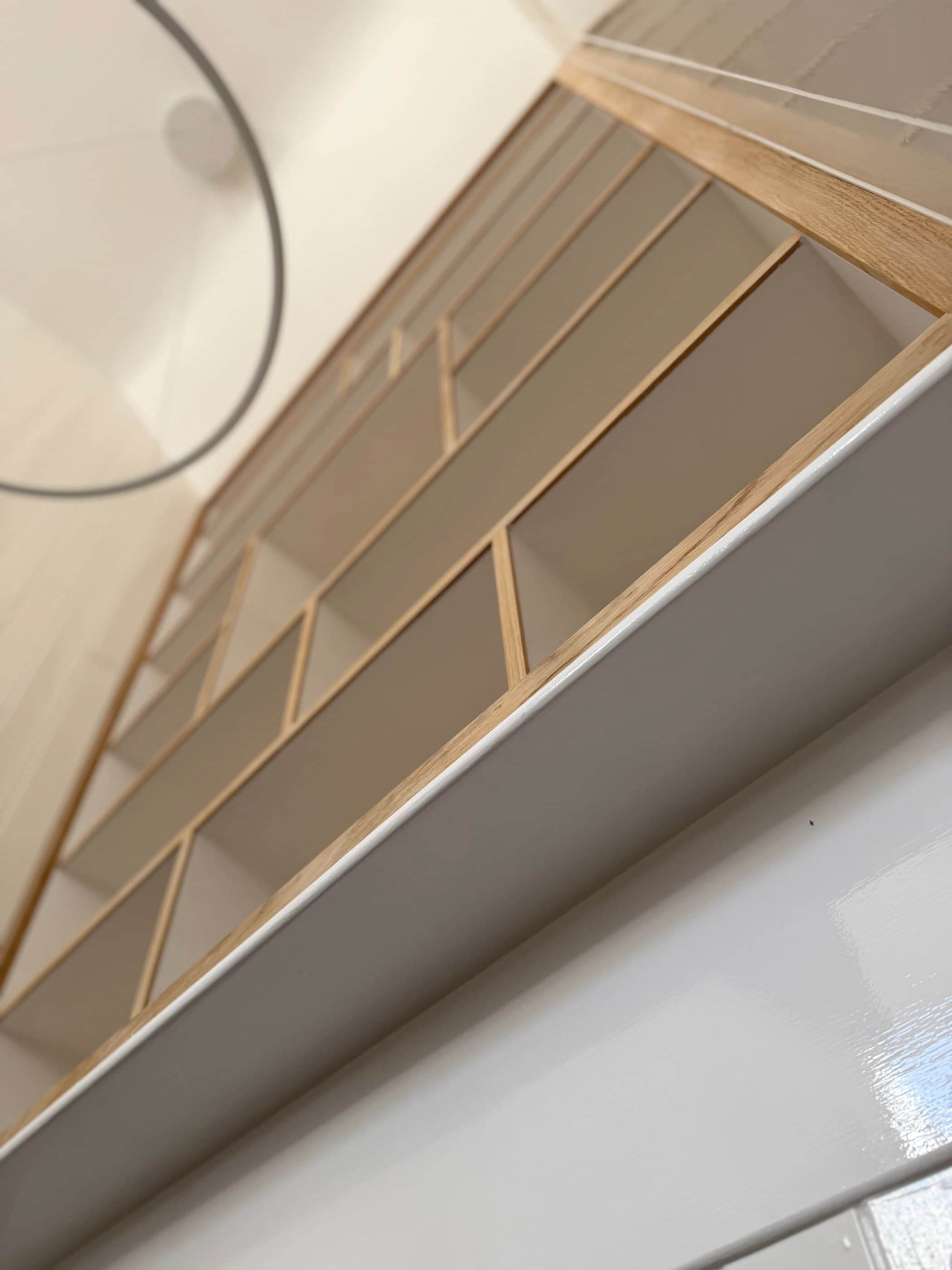
The specification, not the adjectives.
Every joiner in the county will tell you they use quality materials. That sentence carries no information. These are the actual standards the work is built to, each one named so you can look it up and hold anybody else to the same line.
- 6–10%Moisture content
BS EN 942 puts the moisture content of timber in a home heated above 21°C at six to ten per cent, and at nine to thirteen where the heating sits between 12°C and 21°C. Board delivered wetter than the room it is going into will give that water up afterwards, and shrink while it does. You never see it happen. You see the result about four months later, as a hairline crack opening along a painted joint. So material acclimatises in the conditions it is going to live in before anybody cuts it.
BS EN 942:2007 — Timber in joinery: general requirements
- Per partWhich board, and where
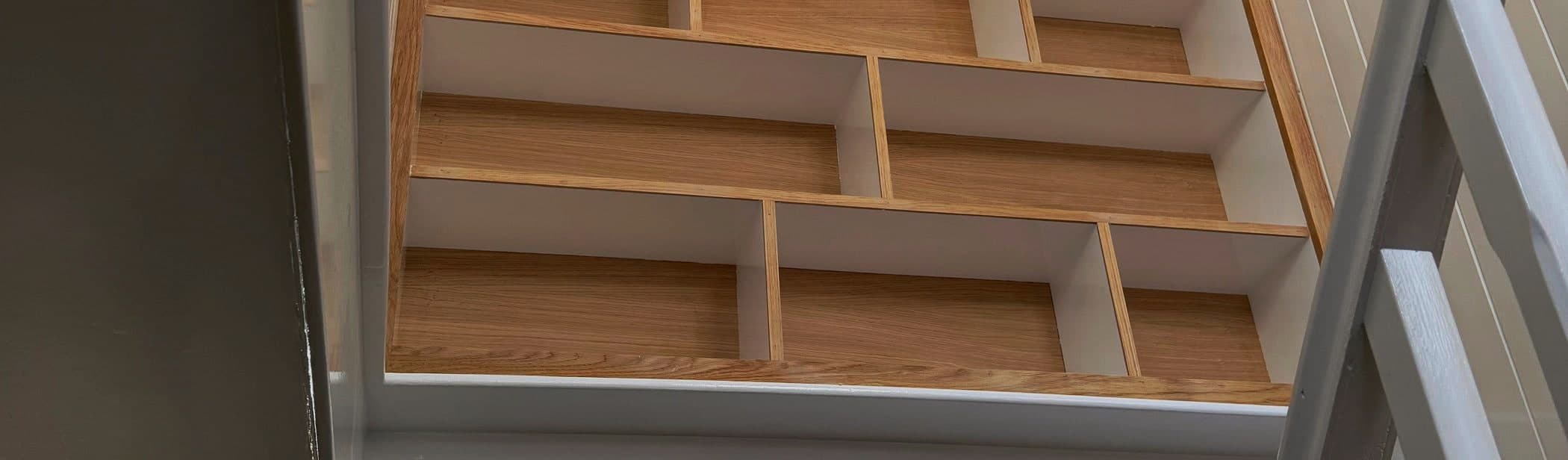
Painted fitted furniture is not one material throughout. MDF takes paint better than anything else because it has no grain to raise, which is what doors and face frames want. Where a fixing has to hold real weight, or a shelf has to span far enough to take a permanent set under books, plywood does work that MDF cannot — and the answer to a long span is a thicker section, a stiffening lip or a mid support, decided at drawing stage rather than discovered two years later. Rooms that get wet twice a day change the answer again. Your drawing names the board for every part, so you can see which is which.
Specified per component on your drawing, by name
- Nothing is squareScribing happens on site
Walls lean, floors fall away, ceilings are not parallel to either, and a chimney breast is rarely the same width at the top as at the bottom. Fitted work is therefore cut oversize on the wall side and trimmed to the line the wall actually takes, in your house, with the piece held against it. There is no way to do that in a workshop, and no way at all to do it flat-packed — which is why flat-pack gets packed out with a strip of timber and a bead of caulk, and why that bead opens up within about a year.
The reason we measure and fit with the same pair of hands
- 200,000Ironmongery, rated in cycles
Blum publish the number: their hinges are tested through 200,000 opening and closing cycles, and their Movento and Tandem runners through 100,000, which the company puts at roughly twenty years of domestic use. On its own, “soft-close” is a word anybody can type. A cycle count is a test result someone had to pay for. Ask whichever firm you use for the figure rather than the adjective, and ask what is actually going in your job.
Blum published test data — worth asking any joiner to match
- Edges firstThe finish is preparation
A cut MDF edge is thirsty and rough, and if it is painted straight it stays visibly rough for the life of the piece. Edges get filled and sealed before any topcoat goes near them. Hand-painted work on site takes longer than sprayed work off site for one unglamorous reason: each coat has to actually dry rather than merely feel dry, and rushing that is what produces a finish that chips off a corner in year two.
Sprayed off site for a harder film, hand-painted on site to match a room
- Use Class 4Outside is a different standard
BS EN 335 sorts external timber by how wet it is going to get. Anything in ground contact — a fence post, a gate post, the bearers under a deck — is Use Class 4. Anything outdoors but clear of the ground is Use Class 3. A UC4 post and a UC3 rail are indistinguishable the day they go in and are completely different objects by year five. Fences almost never fail in the middle of a panel. They fail at the post, at the line where the soil stops.
BS EN 335, with preservative treatment to BS 8417

The jobs we turn down.
A firm that says yes to everything is telling you it needs the work more than it needs to do it well. These are the ones we hand back, and the reasoning, so you can decide whether you agree with it.
01
When you do not need us
A square alcove of an ordinary width, holding ordinary things, does not need bespoke joinery. An off-the-shelf unit will cost a fraction and look fine. We would rather say that at the visit, having driven to you for nothing, than sell you a made-to-measure version of something you could buy on a Tuesday.
02
Plumbing, electrics, plastering, tiling
We coordinate with people qualified to do those things rather than pretending to be them. You get one point of contact and a sequence that works, and the part of the job that needs a certificate is done by someone who can issue one.
03
“While we’re here”
Nothing gets added to a job mid-way because a gap presented itself. If something genuinely should change once the wall is open, it gets drawn, priced and agreed in writing before anyone picks up a tool. A verbal extra on day three is how a fixed price stops being fixed.
04
A price on the day
We do not sit at your table producing a figure, then a better figure, then a discount that expires at midnight. You get a drawing and a fixed written price a few days later, and the law gives you fourteen days after that to change your mind. Anyone who needs your signature tonight is telling you something.
05
Painted work against wet plaster
Fresh plaster holds a great deal of water and gives it up slowly. Fitted joinery scribed and painted against a wall that is still drying will move, and the caulk line will open. If your plasterer has just left, we would rather move the date than hand you something that looks wrong by Christmas.
Facts you can check, not adjectives.
Anyone can type “fully qualified”; the phrase has no legal meaning and no minimum attached. What is listed here is checkable. Where an entry is still a marker, it is because RGS Carpentry has not confirmed it yet — this site is built so that an unconfirmed fact shows up as a gap rather than quietly becoming a plausible number.
- Drawing before deposit
- Every job
- You approve a drawing and a written specification before anything is ordered or cut. You cannot approve what you have not seen.
- Workmanship guarantee
- 1 year
- How long we come back and put our own workmanship right, free.
- Your right to cancel
- 14 days
- Consumer Contracts Regulations 2013, set out in writing with every quote. Not optional, and not ours to waive.
We do not display trade-body badges we do not hold. When accreditations are in place they will appear here as links to the verifiable public profile, because a badge that does not link anywhere reads as decoration.
How to check any carpenter, including us.
These are not questions to ask us. They are questions to take to all three quotes, because the answers separate firms far more reliably than a gallery does. If ours are not the best answers you get, use somebody else.
Can I see a drawing before anything is ordered or cut?
A good answer
Yes, along with a written specification naming the actual materials and finishes, not “high quality materials throughout”.
What a bad one costs you
A price with no drawing. You cannot approve what you have not seen, and you cannot hold anyone to it afterwards.
Who will actually be in my house, and on which days?
A good answer
Names, and a straight answer about subcontractors. There is nothing wrong with subcontracting; there is something wrong with not mentioning it until someone unexpected is on the doorstep.
What a bad one costs you
“The team.” Ask again.
What is the price if I change my mind halfway through?
A good answer
A written variations procedure, however short. It exists precisely so that neither of you has to rely on remembering a conversation.
What a bad one costs you
A shrug, or “we’ll sort it out”. That is the same sentence at the start and at the invoice, and it means different things each time.
Check it yourself
Anyone who carries waste away from your home in the course of business must hold a public registration. Search a name or a number on the Environment Agency public register.
Know the rule
Your cancellation rights on a contract signed at home are set out by the Consumer Contracts Regulations 2013, not by whoever is quoting you.

Tell us what you are trying to fit, and where it has to go.
Four quick questions, no essay and no obligation. We will come and measure, and you will have a drawing and a fixed price within a week.
Every enquiry answered within one working day.