
Service
Garden joinery: gates, fencing, stores and decking
RGS Carpentry builds garden joinery across Surrey: gates, fencing, bin and log stores, pergolas, decking and one-off pieces like tables built around living trees. Outdoor work is unforgiving: everything moves, everything gets wet, and the details that keep water off end grain are the difference between eight years and eighteen.
- Lead time
- 3–5 weeks
- Waste removal
- Licensed disposal included
- Posts
- Concrete-set below frost depth
The anatomy of a gate that does not drop.
Outdoor timber does not rot evenly. It rots at end grain, at ground contact, and wherever two pieces trap water between them.
Our own setting-out drawing, not a photograph. Numbers key to the notes belowalongside.
Weathered top rail
The top edge is cut to a fall so water runs off rather than sitting on end grain. This one detail buys years, and it is the first thing left off a cheap gate.
Strap hinges reaching across the boards
A long strap hinge spreads the load across several boards rather than concentrating it on the hanging stile. Short butt hinges on a heavy gate will pull out, and it is usually the fixing that fails, not the hinge.
The brace runs up from the hinge side
Drawn solid, the way it works. The brace goes into compression and transfers the gate’s weight down to the bottom hinge. Run the other way — drawn dashed — it is in tension, timber joints are poor in tension, and the gate drops. This is the single most common mistake in domestic gate-making.
Boards over the frame
Boarding sits on the face and is nailed or screwed through into the ledges. Fixings are set so they do not split the board ends, and the boards are gapped for movement rather than butted tight.
The post, set below frost depth
Concrete-set, deep enough that seasonal ground movement does not lift or lean it. A gate is only as square as the post it hangs on, and no amount of adjustment at the hinge compensates for a post that moves.
What you actually get.
- Framed, ledged and braced gates hung on galvanised or japanned ironmongery
- Fencing with posts concrete-set below frost depth
- Bin stores, log stores and bike stores with proper falls and roofing
- Pergolas, canopies and garden structures
- Decking, including sub-frame, drainage and ventilation
- One-off pieces: outdoor tables, benches, planters, screens
- Removal and disposal of the old structure by a licensed waste carrier
What it is made from, and why.
The question that decides how a piece ages, and the one almost nobody asks before signing.
- Tanalised softwood
- Pressure-treated redwood, and the sensible default for most garden work. Untreated softwood sapwood is classed as not durable and will not last outside; treatment is what makes it viable. Every cut you make afterwards exposes untreated timber and needs end-grain preservative.
- Western red cedar
- Naturally durable, light, stable and it silvers beautifully. Soft, though — it dents and it is a poor choice for a gate that gets kicked or a deck that takes furniture.
- European oak
- The most durable of the three and by some distance the dearest. It also stains anything below it with tannin for the first couple of years, and it needs stainless or hot-dip galvanised fixings, because oak’s tannins corrode plain steel quickly.
- Ironmongery
- Hot-dip galvanised or japanned, never electroplated, and stainless where it is in contact with oak. Ironmongery is where cheap gates fail first, and it is a small part of the cost.
Why two quotes for “the same job” differ by thousands.
Nobody else in Surrey publishes this. It is the difference between a number you can plan around and a number you have to take on trust.
Guide prices
- Bespoke side gate, hung and ironmongered
- £600 – £1,500
- Bin store or log store
- £900 – £2,200
- Fencing, per metre installed
- £85 – £180
Indicative 2026 figures for Surrey, including materials and fitting. A guide, not a quote. Your quote is fixed, in writing, and comes after we have measured.
- Timber, roughly in that order of cost: tanalised softwood, cedar, oak
- Ground conditions and how much digging and concreting is involved
- Ironmongery quality, which is where cheap gates fail first
- Access: whether materials can be driven in or have to be carried through the house
- Whether the old structure needs removing and disposing of
- Ground levels: a fence run on a slope is stepped or raked, and both cost more than a level run
- Whether anything is on a boundary, which is a conversation to have with a neighbour before we start
From the first visit to the last adjustment.
Design visit
We measure the run, look at the ground and check the levels. On a boundary we will ask who owns the fence, because that conversation is much better had before than after.
Drawing and fixed price
For anything one-off — a gate, a store, a pergola — you get a drawing. For a straight fence run, a written specification of post size, spacing and depth.
Strip out and post setting
Old structure out and away. Posts dug and concrete-set, then left to go off before anything hangs on them.
Making and fitting
Gates and stores made and hung, boarding fixed, roofs formed to a fall.
Finish and end grain
Every cut end treated, because tanalising only protects the timber the treatment reached. This is a ten-minute job that decides how the whole thing ages.
The published figures, not our opinion.
Where a real standard governs the work, here it is, with the numbers in it. You can check every one of these against the source.
Timber durability, BS EN 350
Natural durability against fungal decay runs from Class 1, very durable, to Class 5, not durable. European oak heartwood is Class 2, durable. Western red cedar is Class 2 to 3. Softwood sapwood — which is most of what a fencing merchant sells — is Class 5, not durable, which is precisely why it is pressure-treated. Detailing still beats species: badly detailed oak that traps water will fail before well-detailed treated softwood that sheds it.
Waste carrier registration
Anyone removing waste from your property in the course of business must be a registered waste carrier with the Environment Agency. As the householder you carry a duty of care over where your waste ends up, so it is always worth asking any trade how the old fence will be disposed of.
When not to call us
For a long run of plain lap panels between concrete posts, a fencing contractor will be quicker and cheaper than us and the result will be the same. What we are for is the gate, the store, the screen, the pergola — anything made rather than assembled, and anything that has to fit a space with no standard size.
Garden joinery, photographed as we left them.
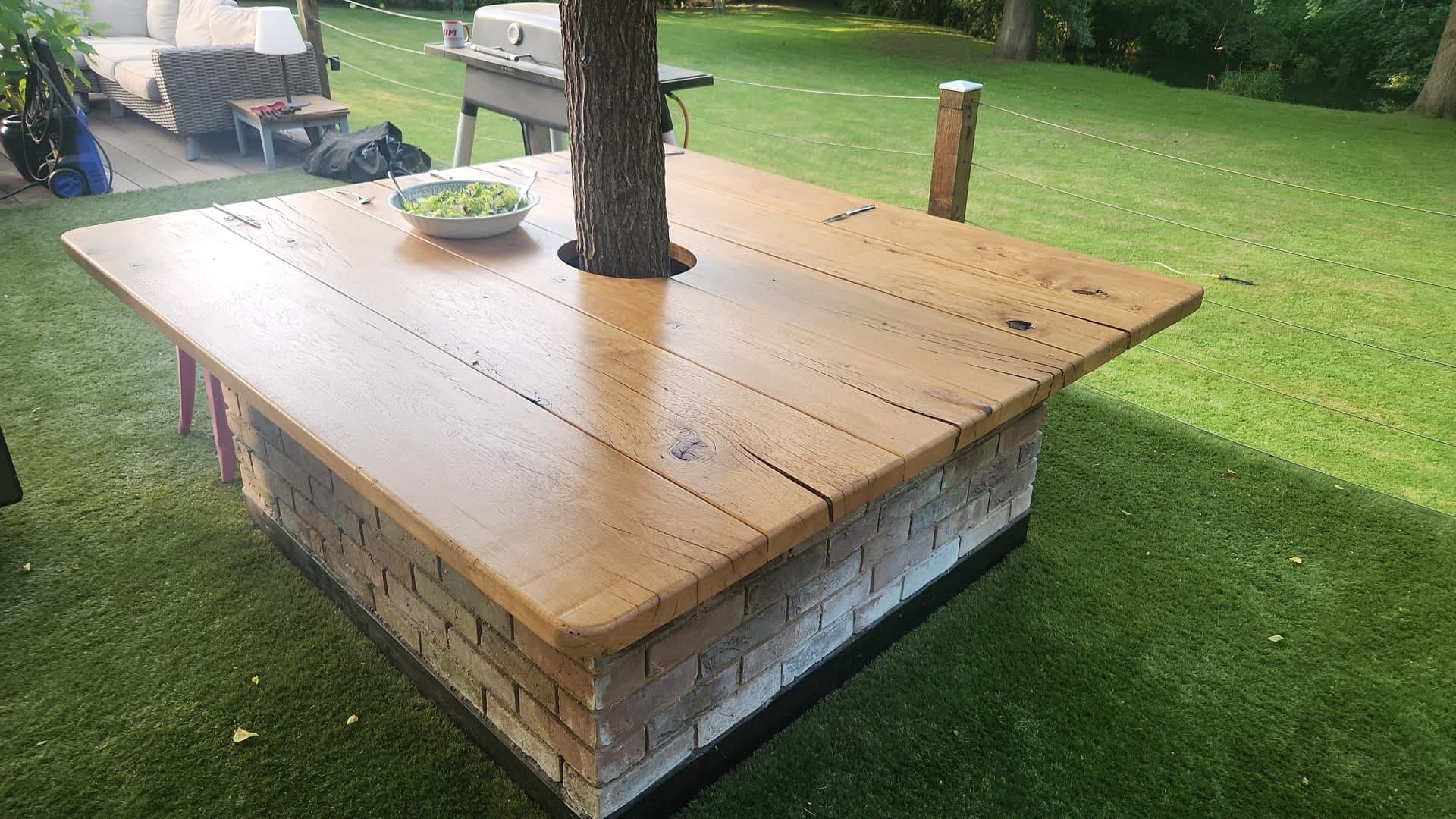
Oak table built around a living tree
A solid oak garden table built in place around a mature trunk, on a brick plinth.
Solid European oakReclaimed brick plinth
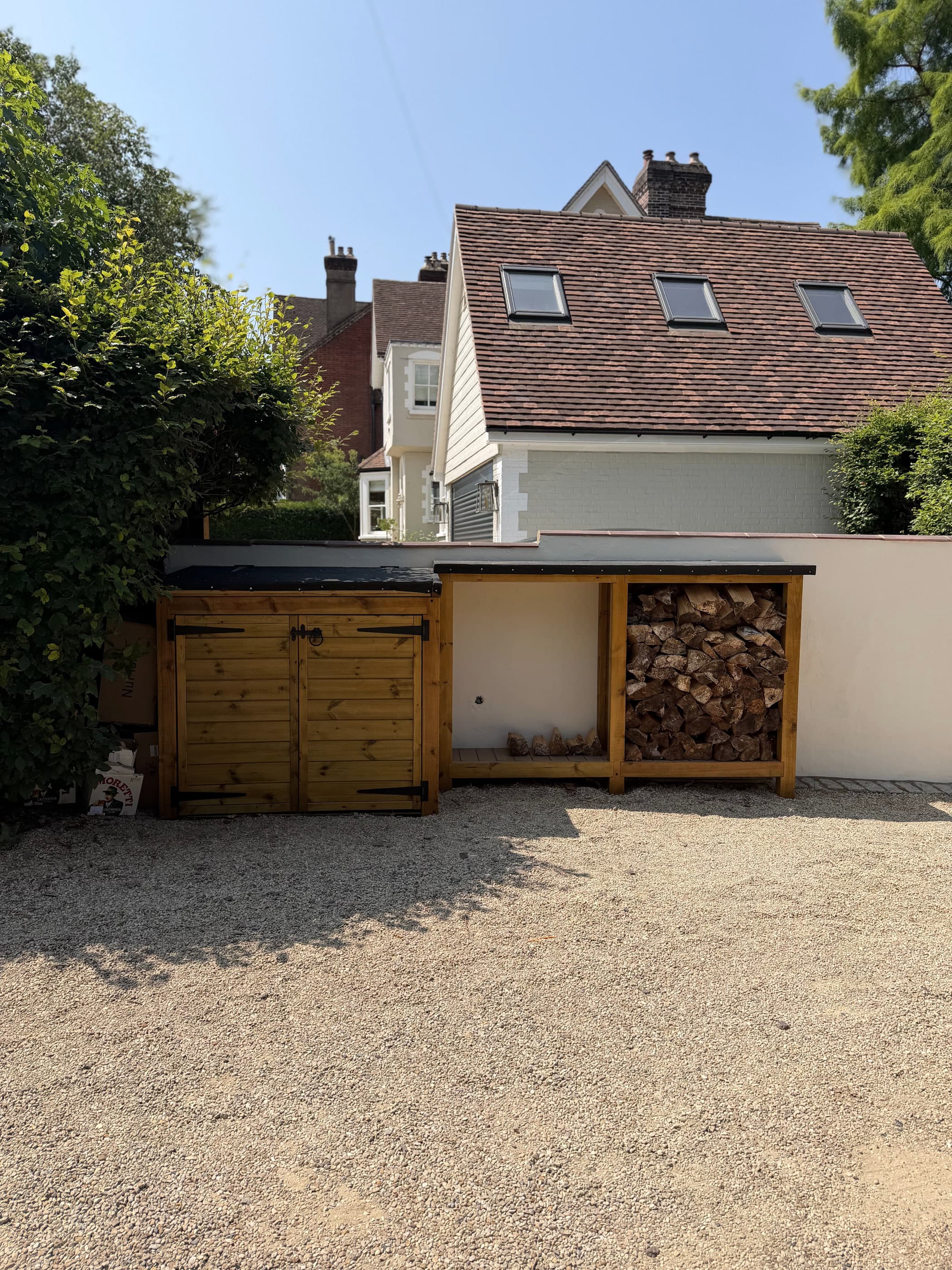
Bin store and log store
A matched pair of stores along a driveway wall: bins hidden, logs stacked and drying.
Tanalised softwoodEPDM flat roof
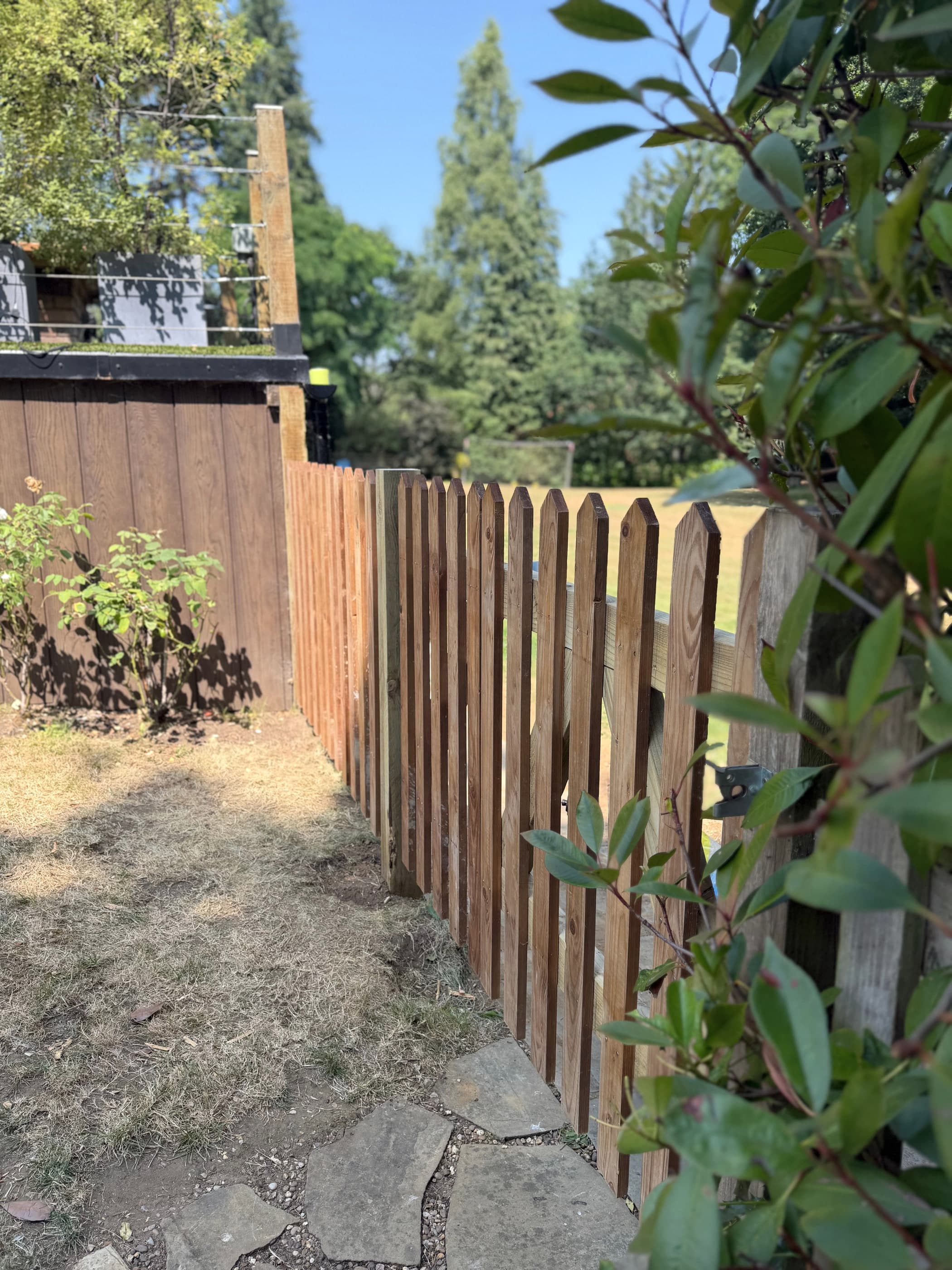
Picket fencing and braced gate
A run of pointed picket fencing and a braced gate dividing a garden from open parkland.
Tanalised softwood picketsGalvanised strap hinges
The things people ask first.
What timber lasts longest outside?
Oak and cedar, comfortably — both sit at durability Class 2 under BS EN 350, against Class 5 for untreated softwood sapwood. But tanalised softwood detailed properly and kept off the ground will outlast oak that has been badly detailed. How water gets off end grain matters more than the species.
Why do gates drop?
Almost always because the brace is running the wrong way, or the post is undersized. A brace has to run upward from the hinge side so it works in compression. Run the other way it is in tension, and timber joints are weak in tension — so it does nothing at all.
Do you take the old fence away?
Yes — old fencing and posts are taken away for correctly licensed disposal rather than left in a pile behind the shed. As the householder you have a legal duty of care over where your waste ends up, so it is always worth asking any trade how waste will be disposed of.
How deep should fence posts go?
The usual rule is a quarter to a third of the post’s above-ground height, concrete-set, and always below the depth that freezes and moves. On a tall or exposed run, or in soft ground, deeper. A post that is too shallow will lean within a couple of winters and nothing you do at the top will fix it.
Do I need to treat it again, and how often?
Tanalised timber does not need treating to survive, but every cut you make exposes untreated wood and that does need end-grain preservative. If you want it to hold a colour rather than silver, expect to re-coat every two to three years on a south-facing elevation and rather less often elsewhere.
Whose fence is it?
The deeds decide, and the T-mark on the plan usually shows it: the T sits on the owner’s side. There is no reliable "left-hand side" rule despite what everyone says. It is worth checking before we start, particularly if a post has to go on the boundary line.
Garden joinery across Surrey.
Each town page describes the building stock we are actually working with there, which is what decides how a job like this is detailed.

Tell us what you are trying to fit, and where it has to go.
Four quick questions, no essay and no obligation. We will come and measure, and you will have a drawing and a fixed price within a week.
Every enquiry answered within one working day.