
No. 05 · Garden joinery
Picket fencing and braced gate
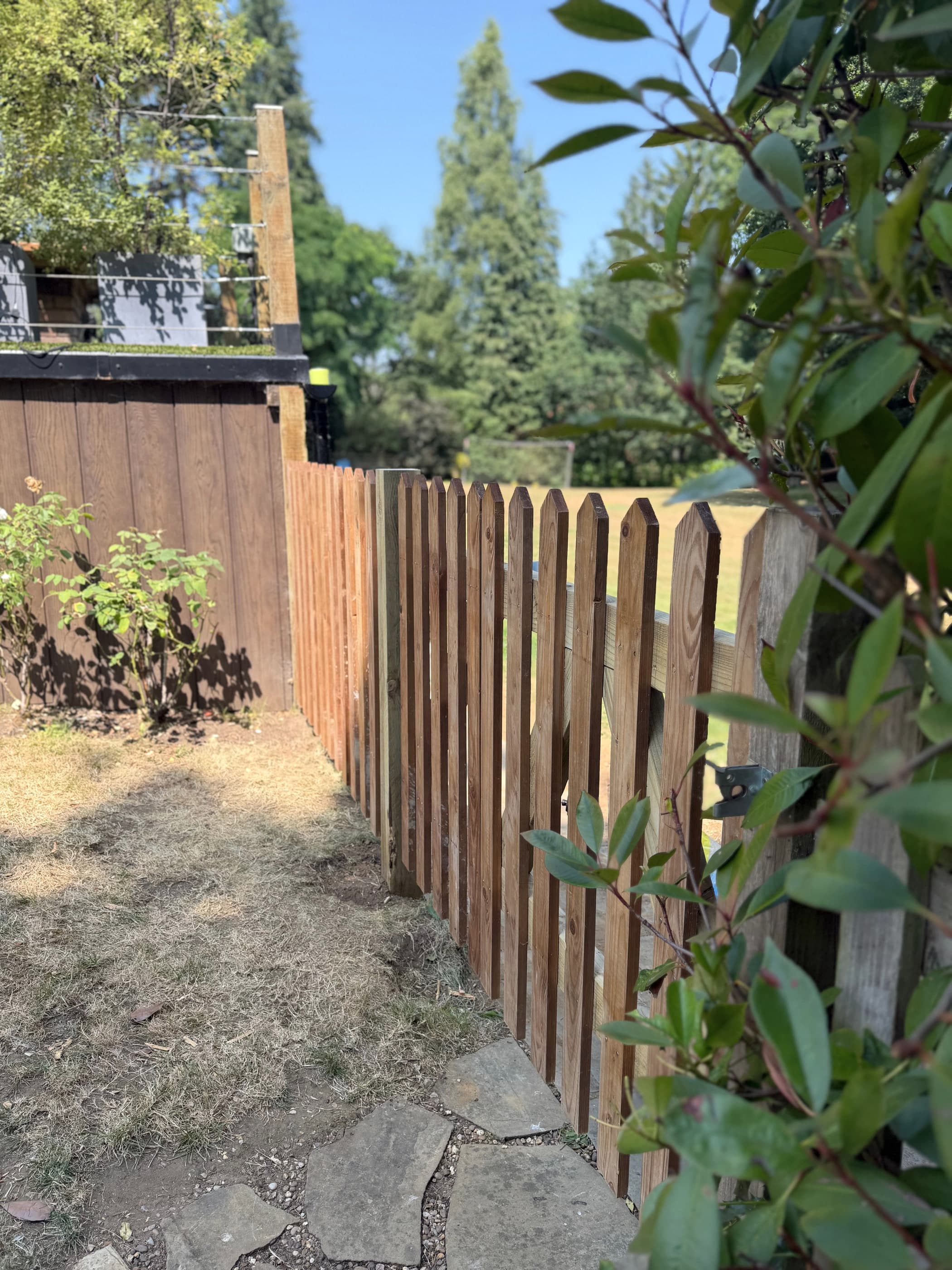
A run of pointed picket fencing and a braced gate dividing a garden from open parkland.
The job
- Discipline
- Garden joinery
- Where
- Surrey, UK
- Guide range
- £600 – £1,500 · bespoke side gate, hung and ironmongered
- Photographs
- 3 of the finished job, plus one mid-install
Materials
- Tanalised softwood pickets
- Galvanised strap hinges
- Concrete-set posts
Boundary · Parkland view · Braced gate · Dog-proof
Or talk it through first. No obligation either way.
The brief
Keeping a dog in without putting a wall across a parkland view.
An open boundary onto parkland that needed to keep a dog in without closing off the view.
What we did about it
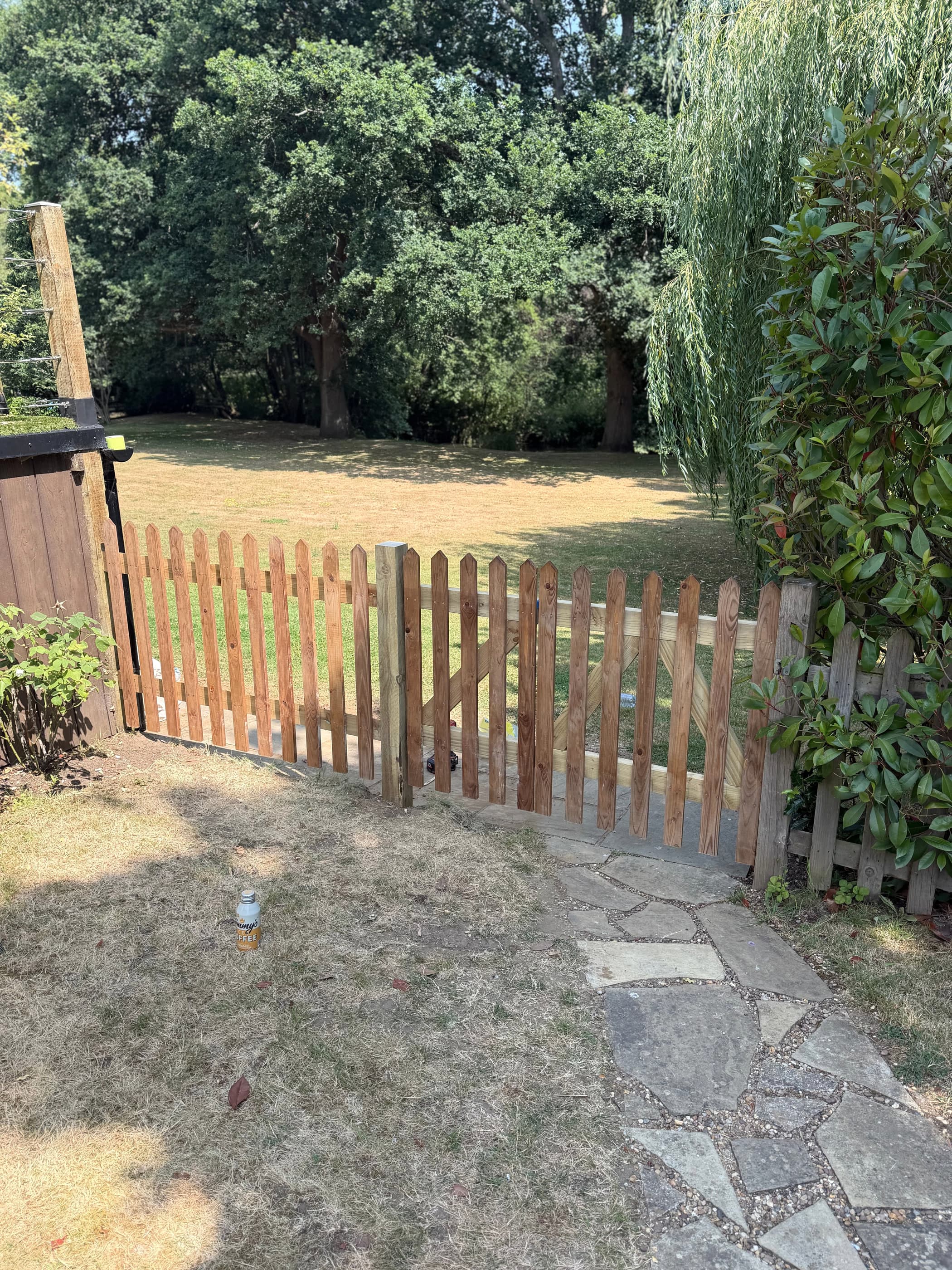
Pointed pickets at a spacing that reads as a boundary from the house but barely interrupts the view from the terrace. Posts are concrete-set below frost depth; the gate is framed, ledged and braced with the brace running from the hinge side upward, which is the way round that actually stops a gate dropping.
Five decisions you cannot see in the photograph.
These are the parts nobody asks about at the quote stage and everybody notices ten years later.
The spacing is set to the dog, not to the timber
Picket spacing is usually whatever falls out of dividing the bay by the board width. Here it was set from the other end: close enough that the animal it exists for cannot get through, open enough that from the terrace you are looking at parkland with some vertical lines in front of it rather than at a fence.
The brace runs up from the hinge side
This is the single most common mistake on a made gate, and it is invisible until the gate has dropped. A brace in compression, running upward away from the bottom hinge, carries the far corner. Fitted the other way round it is a decorative diagonal doing nothing, and the gate is on the ground within a year or two.
Posts concrete-set below frost depth
A post set shallow in wet Surrey clay heaves in a hard winter and never quite goes back, which is why so many fence runs are wavy. Set below the depth frost reaches, in concrete with the shoulder shaped so water runs off rather than sitting against the post, the line stays a line.
Pointed tops, because that is where a picket rots
A picket fails at the top first: exposed end grain drinks water like a straw and holds it. A point sheds water sideways off that end grain. It also happens to be the traditional profile, so the detail that keeps the fence standing is the same one that makes it look right.
Hung to be adjustable
Every gate outdoors moves. Strap hinges through-bolted rather than screwed mean the hang can be corrected in ten minutes years later, instead of the whole gate being scrap because four screws have pulled out of a wet post.
Drag to see how it went in.
A mid-install frame and the finished job from the same position. We have not staged a “before”. We simply did not photograph the old boundary, and inventing one would be a small lie.
 Mid-installFinished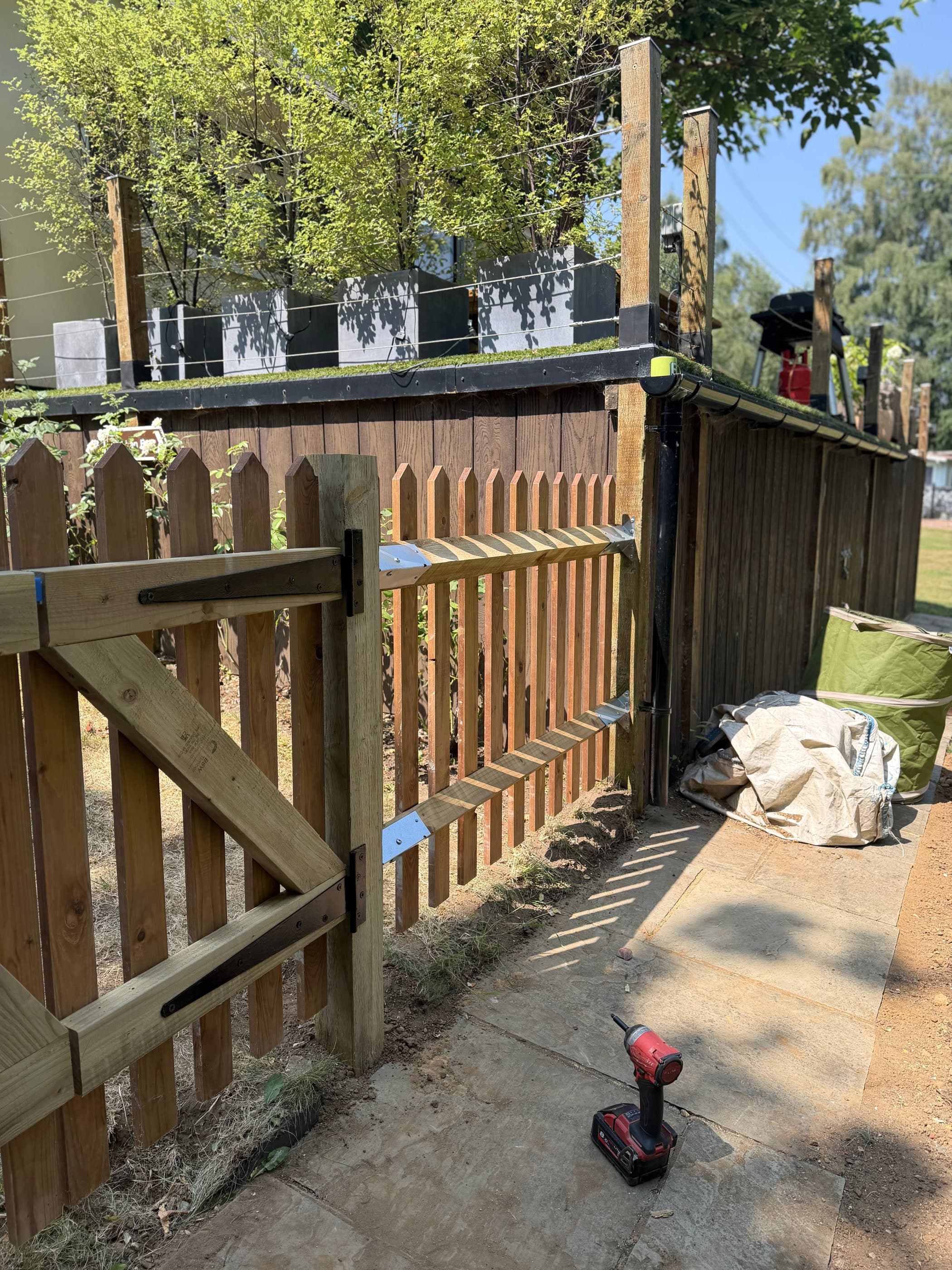
The rest of the job, uncropped.
Shot on the day we finished, in the light that was there. Nothing has been staged, styled or straightened afterwards.
The gate reads as part of the run rather than an interruption in it. 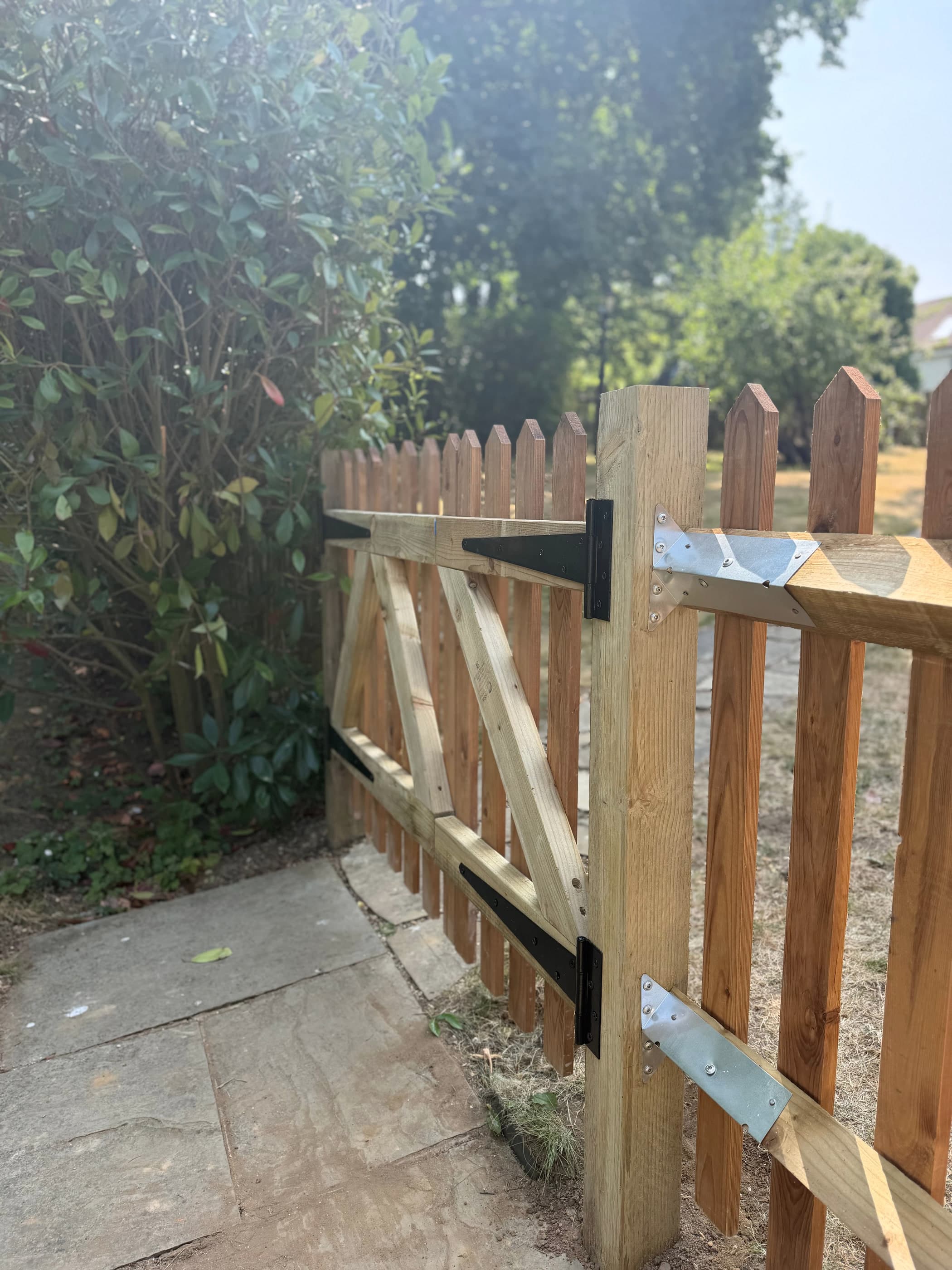
Brace runs up from the hinge side, the way that stops a gate dropping.
Specification
What it is actually made of.
If you are holding two quotes for work like this, compare them here rather than on the total. The difference between a number and a much lower number is almost always in this list.
- Pickets
- Tanalised softwood, pointed tops
- Posts
- Tanalised, concrete-set below frost depth
- Gate
- Framed, ledged and braced, brace rising from the hinge side
- Ironmongery
- Galvanised strap hinges, through-bolted
- Cut ends
- End-grain treated before fixing, every one
- Line
- Set out to the ground as it falls, not to a laser and packers
Why it lasts
Fence runs fail at three points: the post below ground, the end grain on top, and the gate hinge. All three are dealt with here specifically, which is most of what separates a fence you replace in eight years from one you do not.
Roughly what work like this runs to.
Not one of the sixteen Surrey competitors we profiled publishes a price. These are guide ranges for this kind of job, so you can decide whether to call before you call.
- Bespoke side gate, hung and ironmongered
- £600 – £1,500
- Bin store or log store
- £900 – £2,200
- Fencing, per metre installed
- £85 – £180
Indicative 2026 figures for Surrey, including materials and fitting. A guide, not a quote. Your quote is fixed, in writing, and comes after we have measured. All guide prices.
Asked most about garden joinery.
- What timber lasts longest outside?
- Oak and cedar, comfortably — both sit at durability Class 2 under BS EN 350, against Class 5 for untreated softwood sapwood. But tanalised softwood detailed properly and kept off the ground will outlast oak that has been badly detailed. How water gets off end grain matters more than the species.
- Why do gates drop?
- Almost always because the brace is running the wrong way, or the post is undersized. A brace has to run upward from the hinge side so it works in compression. Run the other way it is in tension, and timber joints are weak in tension — so it does nothing at all.
- Do you take the old fence away?
- Yes — old fencing and posts are taken away for correctly licensed disposal rather than left in a pile behind the shed. As the householder you have a legal duty of care over where your waste ends up, so it is always worth asking any trade how waste will be disposed of.
More on how this work is done, and what changes the price, on the garden joinery page.
Keep going

Tell us what you are trying to fit, and where it has to go.
Four quick questions, no essay and no obligation. We will come and measure, and you will have a drawing and a fixed price within a week.
Every enquiry answered within one working day.