
No. 06 · Garden joinery
Framed, ledged and braced side gates
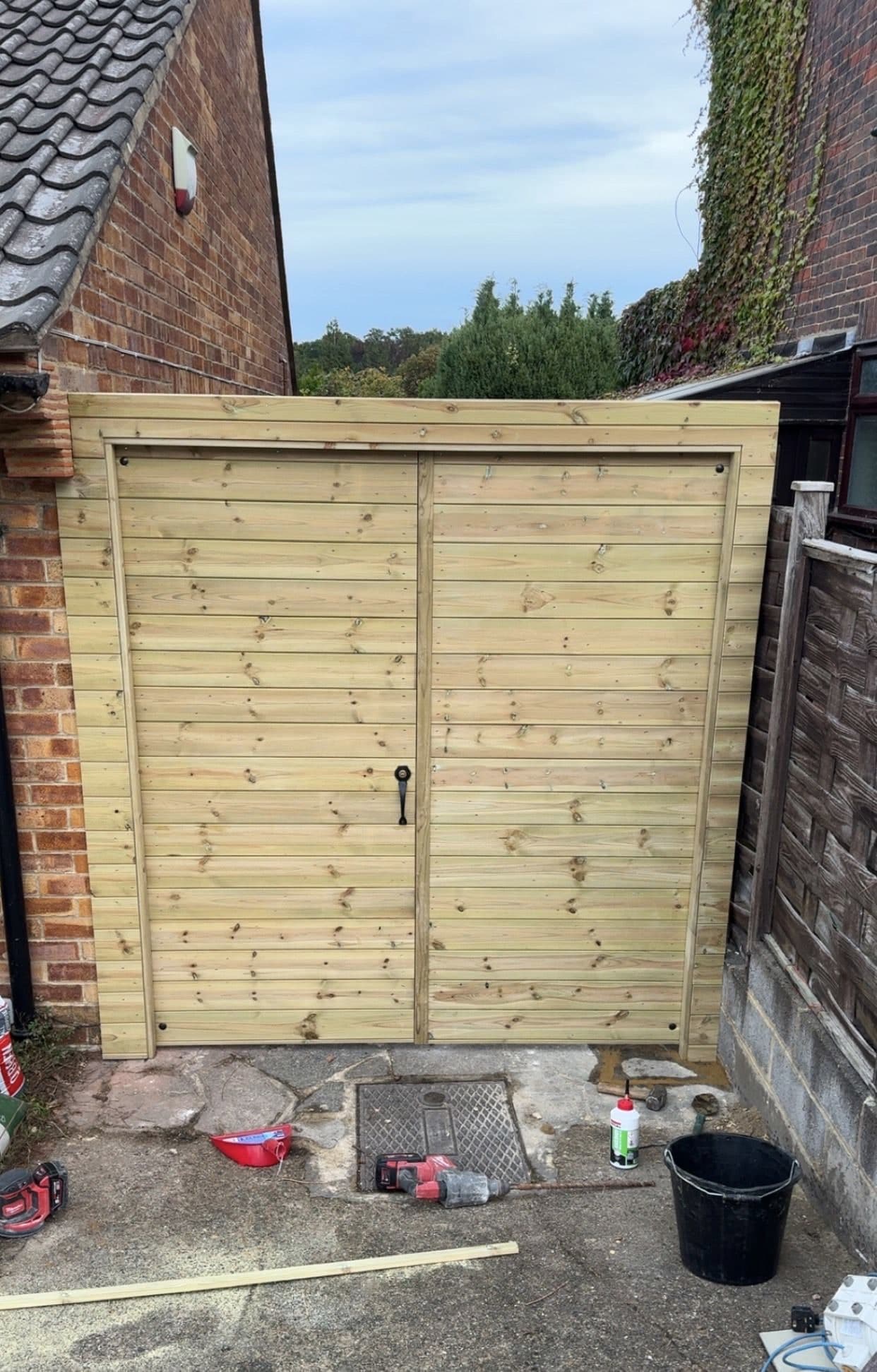
A pair of full-height gates closing a side return: braced on the garden face, close-boarded to the street.
The job
- Discipline
- Garden joinery
- Where
- Surrey, UK
- Guide range
- £600 – £1,500 · bespoke side gate, hung and ironmongered
- Photographs
- 2 of the finished job
Materials
- Tanalised softwood
- Close-boarded cladding
- Black japanned strap hinges
- Through-bolted frame
Security · Side return · Storage · Full height
Or talk it through first. No obligation either way.
The brief
A side return too wide for one gate, too visible for a pair of plain slab doors, and an alley behind it doing nothing but collecting leaves.
An open side return giving anyone straight access to the back garden, on a run too wide for a single gate, with a dead alley behind it that the client wanted turned into dry storage.
What we did about it
A pair of framed, ledged and braced gates hung off a through-bolted frame rather than the brickwork alone. Full height to the top of the frame so there is nothing to climb, close-boarded on the street face with the ledges and braces to the garden side, and sized from what was going in the alley rather than from the opening. Drop bolts into the ground, and a lock rail at a height that works from both sides.
Seven decisions you cannot see in the photograph.
These are the parts nobody asks about at the quote stage and everybody notices ten years later.
A pair, because leverage is not negotiable
Every extra hundred millimetres of width multiplies the load trying to pull the top hinge out of the post. Past about a metre a single timber gate is fighting physics for the rest of its life. Splitting the opening into two leaves halves the leverage on each and is the reason these will still be closing squarely in a decade.
Hung off a frame, not off the brickwork
Old brick and lime mortar will take a hinge bolt right up until the day it does not, usually taking a fist-sized piece of the wall with it. A timber frame through-bolted across several courses spreads that load, and if anything ever does need doing it is done to the frame rather than to the house.
Full height, with nothing to stand on
A gate with a gap above it is a gate with a handhold, and a gate with a rail on the outside face is a ladder. These run to the top of the frame, and the ledges and braces are on the garden side, so the street face is a flat sheet of close-boarding with nothing to get hold of and nothing to put a foot on. Both photographs on this page are the same pair of gates, shot from either side, which is the clearest way to show it.
Sized from what was going in the alley
The opening width was set by measuring the bike and the mower first, then the gates were drawn around that, rather than fitting the widest leaves the return allowed and hoping. A store you have to angle things into is a store that ends up holding nothing but a hose.
Ventilated rather than sealed
Closing an alley off makes it storage, and a sealed timber box in an alley is a condensation trap that returns tools rusted. Close-boarding breathes at the joints and the gates are hung with a clearance top and bottom, so air moves and what goes in dry comes out dry.
Drop bolts and a lock rail set for both sides
One leaf is pinned into the ground top and bottom so it acts as a fixed post, and the working leaf shuts against it. The lock rail is at a height that can be reached over from outside without being at head height for a child inside, which sounds obvious and is regularly got wrong.
Black japanned rather than galvanised
Galvanised ironmongery is the default and reads as agricultural against a brick house. Black japanned strap hinges cost a little more, sit properly against dark stained timber and brickwork, and are the detail that makes a security gate look like it was chosen rather than bought.
The rest of the job, uncropped.
Shot on the day we finished, in the light that was there. Nothing has been staged, styled or straightened afterwards.
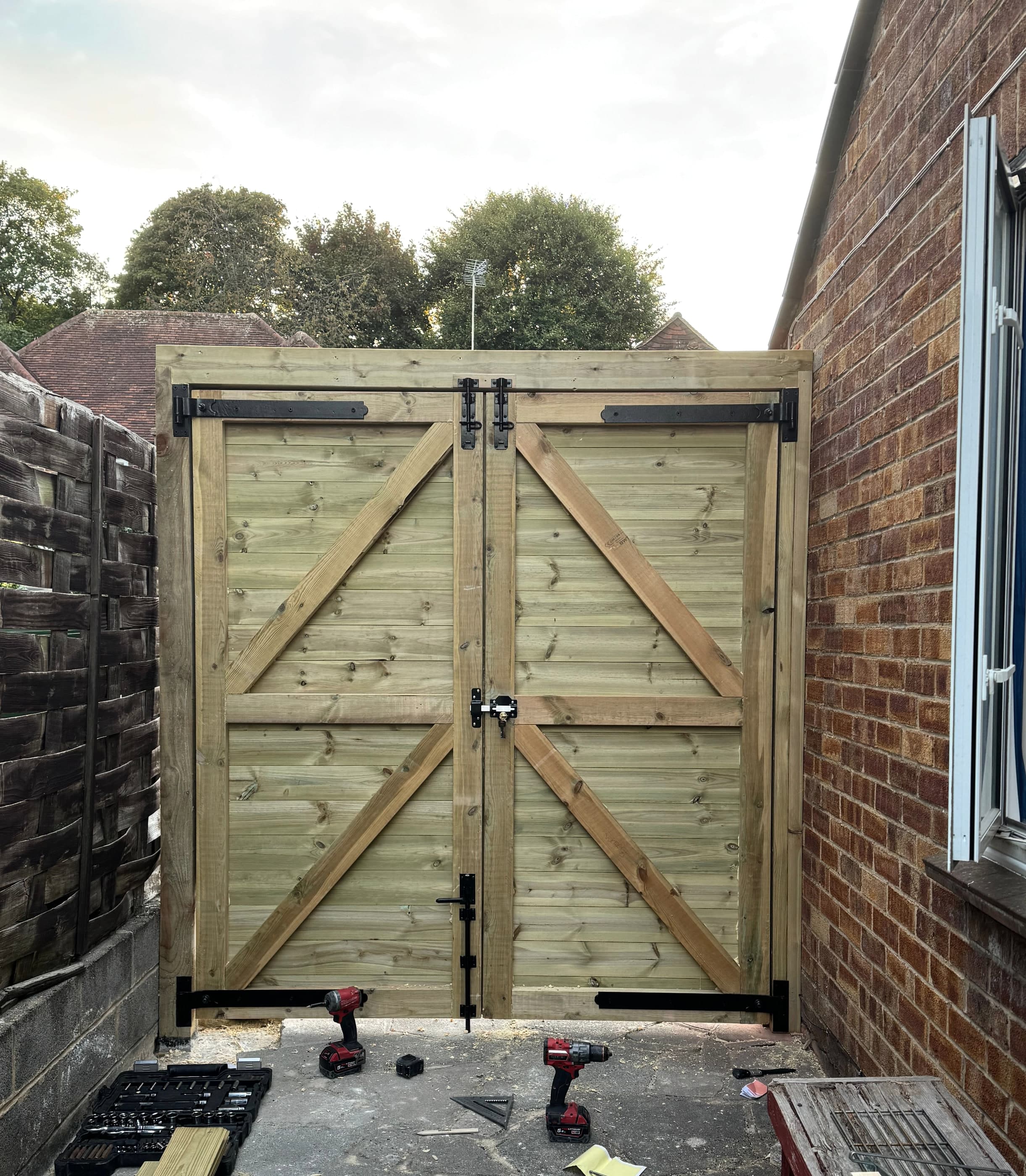
The same gates from the garden side, where the bracing lives.
Specification
What it is actually made of.
If you are holding two quotes for work like this, compare them here rather than on the total. The difference between a number and a much lower number is almost always in this list.
- Gates
- Framed, ledged and braced, hung as a pair
- Frame
- Tanalised softwood, through-bolted across the opening
- Ironmongery
- Black japanned strap hinges
- Security
- Drop bolts to ground on the slave leaf, lock rail on the working leaf
- Height
- Full height to the head of the frame, no gap above
- Bracing
- Ledges and braces to the garden side
- Cladding
- Horizontal close-board to the street face
- Sizing
- Set from the bike and the mower, not from the opening
- Ventilation
- Clearance top and bottom, breathable board joints
Why it lasts
Gates fail at the hinge and at the bottom rail. The hinges here are through-bolted into a frame rather than screwed into masonry, and the gates hang clear of the ground rather than brushing it, which are the two things that decide it. Nothing has been built that has to be maintained as a structure — only a pair of gates that can be rehung on their own.
Roughly what work like this runs to.
Not one of the sixteen Surrey competitors we profiled publishes a price. These are guide ranges for this kind of job, so you can decide whether to call before you call.
- Bespoke side gate, hung and ironmongered
- £600 – £1,500
- Bin store or log store
- £900 – £2,200
- Fencing, per metre installed
- £85 – £180
Indicative 2026 figures for Surrey, including materials and fitting. A guide, not a quote. Your quote is fixed, in writing, and comes after we have measured. All guide prices.
Asked most about garden joinery.
- What timber lasts longest outside?
- Oak and cedar, comfortably — both sit at durability Class 2 under BS EN 350, against Class 5 for untreated softwood sapwood. But tanalised softwood detailed properly and kept off the ground will outlast oak that has been badly detailed. How water gets off end grain matters more than the species.
- Why do gates drop?
- Almost always because the brace is running the wrong way, or the post is undersized. A brace has to run upward from the hinge side so it works in compression. Run the other way it is in tension, and timber joints are weak in tension — so it does nothing at all.
- Do you take the old fence away?
- Yes — old fencing and posts are taken away for correctly licensed disposal rather than left in a pile behind the shed. As the householder you have a legal duty of care over where your waste ends up, so it is always worth asking any trade how waste will be disposed of.
More on how this work is done, and what changes the price, on the garden joinery page.
Keep going

Tell us what you are trying to fit, and where it has to go.
Four quick questions, no essay and no obligation. We will come and measure, and you will have a drawing and a fixed price within a week.
Every enquiry answered within one working day.